


アトモキセチン
 | |
 | |
| IUPAC命名法による物質名 | |
|---|---|
| |
| 臨床データ | |
| 胎児危険度分類 | |
| 法的規制 | |
| 投与経路 | Oral (Capsules: 10, 18, 25, 40, and 60 mg; in some countries 80 and 100 mg are also available) |
| 薬物動態データ | |
| 生物学的利用能 | 63 to 94% |
| 血漿タンパク結合 | 40% |
| 代謝 | Hepatic, via CYP2D6 |
| 半減期 | 5 hours |
| 排泄 | Renal (>80%) and fecal (<17%) |
| 識別 | |
| CAS番号 | 83015-26-3 |
| ATCコード | N06BA09 (WHO) |
| PubChem | CID: 54841 |
| DrugBank | APRD00614 |
| ChemSpider | 49516 |
| KEGG | D07473 |
| 化学的データ | |
| 化学式 | C17H21NO |
| 分子量 | 255.355 g/mol 291.820 g/mol (hydrochloride) |
| |
アトモキセチン(英語: Atomoxetine)はノルアドレナリン再取り込み阻害剤の一種である[1]。日本では商品名ストラテーラ。日本での適応は注意欠陥多動性障害(ADHD)である。医薬品、医療機器等の品質、有効性及び安全性の確保等に関する法律における劇薬である。
中枢神経系の刺激薬であるメチルフェニデートとは異なり、アトモキセチンは非刺激薬とされ乱用性がない[2]。世界保健機関 (WHO) のATC分類ではN06B-精神刺激薬に分類される[3]。
開発と販売[編集]
アメリカのイーライリリー・アンド・カンパニーにより開発された。Strattera、Tomoxetin、Attentinの商品名で販売されている。
日本ではストラテラ (Strattera)の商品名で、日本イーライリリーが製造販売している。18歳未満の注意欠陥多動性障害(ADHD)に対して承認されていたが、2012年に成人期のADHDに対しても承認された[4]。
- 販売例
-
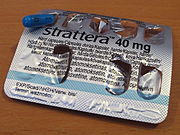
-
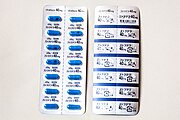 日本国内で流通しているストラテラカプセル(40mg)
 -
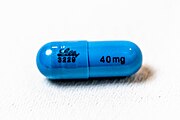 ストラテラカプセル(40mg)


有効性[編集]
成人ADHDに対するシステマティックレビューは、偽薬に比較して小さな効果で中止率も多く、利益と危険性のバランスが悪いため使用の推奨は弱いと結論された[5]。
副作用[編集]
ADHDで使われる他の薬メチルフェニデートとは異なり、乱用性がない[2]。
重大な副作用として、添付文書には肝機能障害、黄疸、肝不全、アナフィラキシーが記載されている[6][7]。
軽度の副作用として現れやすいのは、消化器系で悪心が31.5%、食欲減退が19.9%。神経系で頭痛が15.4%、傾眠が15.8%の人に見られた。他にも、腹痛や口渇、嘔吐や便秘なども見られる。[8]
アメリカ食品医薬品局(FDA)の有害事象報告システム(AERS)のデータから殺人や暴力など他害行為の報告を調査し、アトモキセチンは6位の9倍であった[9]。
アトモキセチンは全ての医薬品の中で、2番目に自殺未遂の報告が多かった[10]。
薬物動態[編集]
肝臓のCYP2D6で代謝される。
薬理[編集]
アトモキセチンは臨床用量でNMDA受容体拮抗作用を有する[11]。
アトモキセチンのNMDA受容体拮抗作用のプロフィールは解明されていない。最近の研究ではADHDの病態生理学にグルタミン酸機能不全が関与していることを示唆している[12][13]。
| タンパク質 | アトモキセチン(nM) | 4-ヒドロキシ-アトモキセチン(nM) |
|---|---|---|
| NMDA受容体(IC50) | 3000[11] | ? |
| セロトニントランスポーター | 77 | ? |
| ノルアドレナリントランスポーター | 5 | ? |
| ドーパミントランスポーター | 1451 | ? |
| セロトニン受容体 | 1000 以上 | ? |
| アドレナリン α受容体 | 1000 以上 | ? |
| アドレナリン β受容体 | 1000 以上 | ? |
| ドーパミン D1 & D2受容体 | 1000 以上 | ? |
| ムスカリン M1 & M2受容体 | 1000 以上 | ? |
| ヒスタミン H1 & H2受容体 | 1000 以上 | ? |
| オピオイド δ1受容体 | ? | 300 |
| オピオイド κ1受容体 | ? | 95 |
| オピオイド μ受容体 | ? | 422 |
| シグマ σ1受容体 | 1000 以上 | ? |
出典[編集]
- ^ Unni JC (July 2006). “Atomoxetine”. Indian Pediatrics 43 (7): 603–6. PMID 16891679 2010年4月19日閲覧。.
- ^ a b Upadhyaya, Himanshu P.; Desaiah, Durisala; Schuh, Kory J.; et al. (2013). “A review of the abuse potential assessment of atomoxetine: a nonstimulant medication for attention-deficit/hyperactivity disorder”. Psychopharmacology 226 (2): 189–200. doi:10.1007/s00213-013-2986-z. PMC 3579642. PMID 23397050.
- ^ WHOCC - ATC/DDD Index
- ^ “注意欠陥/多動性障害(AD/HD)治療剤「ストラテラ®」、日本で初めて、成人期のAD/HDへの適応承認” (2012年8月24日). 2014年10月31日閲覧。
- ^ Cunill, Ruth; Castells, Xavier; Tobias, Aurelio; et al. (2013). “Atomoxetine for attention deficit hyperactivity disorder in the adulthood: a meta-analysis and meta-regression”. Pharmacoepidemiology and Drug Safety (9): n/a–n/a. doi:10.1002/pds.3473. PMID 23813665.
- ^ “ストラテラカプセル5mg/10mg/25mg/40mg 添付文書” (2013年11月). 2016年8月4日閲覧。
- ^ “ストラテラ内用液0.4% 添付文書” (2014年7月). 2016年8月4日閲覧。
- ^ “医療用医薬品 : アトモキセチン (アトモキセチン錠5mg「トーワ」 他)”. www.kegg.jp. 2024年2月19日閲覧。
- ^ Ross, Joseph S.; Moore, Thomas J.; Glenmullen, Joseph; Furberg, Curt D. (2010). “Prescription Drugs Associated with Reports of Violence Towards Others”. PLoS ONE 5 (12): e15337. doi:10.1371/journal.pone.0015337. PMC 3002271. PMID 21179515.
- ^ Thomas KH, Martin RM, Potokar J, Pirmohamed M, Gunnell D. (2014-9-30). “Reporting of drug induced depression and fatal and non-fatal suicidal behaviour in the UK from 1998 to 2011.”. BMC Pharmacol Toxicol. 15: 54. doi:10.1186/2050-6511-15-54. PMC 4184159. PMID 25266008.
- ^ a b Ludolph, AG; Udvardi, PT; Schaz, U; Henes, C; Adolph, O; Weigt, HU; Fegert, JM; Boeckers, TM; Föhr, KJ (May 2010). “Atomoxetine acts as an NMDA receptor blocker in clinically relevant concentrations” (pdf). British Journal of Pharmacology 160 (2): 283–291. doi:10.1111/j.1476-5381.2010.00707.x. PMC 2874851. PMID 20423340.
- ^ Lesch, KP; Merker, S; Reif, A; Novak, M (2013-6). “Dances with black widow spiders: dysregulation of glutamate signalling enters centre stage in ADHD”. European Neuropsychopharmacology 23 (6): 479–91. doi:10.1016/j.euroneuro.2012.07.013. PMID 22939004.
- ^ “New gene study of ADHD points to defects in brain signaling pathways”. Children's Hospital of Philadelphia (2011年12月4日). 2016年5月16日閲覧。
- ^ Roth, BL; Driscol, J (2011年1月12日). “PDSP Ki Database”. Psychoactive Drug Screening Program (PDSP). University of North Carolina at Chapel Hill and the United States National Institute of Mental Health. 2016年5月16日閲覧。
- ^ Bymaster, FP; Katner, JS; Nelson, DL; Hemrick-Luecke, SK; Threlkeld, PG; Heiligenstein, JH; Morin, SM; Gehlert, DR; Perry, KW (2002-12). “Atomoxetine Increases Extracellular Levels of Norepinephrine and Dopamine in Prefrontal Cortex of Rat: A Potential Mechanism for Efficacy in Attention Deficit/Hyperactivity Disorder” (pdf). Neuropsychopharmacology 27 (5): 699–711. doi:10.1016/s0893-133x(02)00346-9. PMID 12431845.
- ^ Creighton, CJ; Ramabadran, K; Ciccone, PE; Liu, J; Orsini, MJ; Reitz, AB (2004-8-2). “Synthesis and biological evaluation of the major metabolite of atomoxetine: elucidation of a partial kappa-opioid agonist effect.”. Bioorganic & Medicinal Chemistry Letters 14 (15): 4083–5. doi:10.1016/j.bmcl.2004.05.018. PMID 15225731.
- ^ Bymaster, FP; Katner, JS; Nelson, DL; Hemrick-Luecke, SK; Threlkeld, PG; Heiligenstein, JH; Morin, SM; Gehlert, DR et al. (November 2002). “Atomoxetine increases extracellular levels of norepinephrine and dopamine in prefrontal cortex of rat: a potential mechanism for efficacy in attention deficit/hyperactivity disorder.”. Neuropsychopharmacology. 27 (5): 699–711. doi:10.1016/s0893-133x(02)00346-9. PMID 12431845.
関連項目[編集]
| ||||||||||||
| ||||||||||||
 カテゴリ カテゴリ | ||||||||||||
 | この項目は、薬学に関連した書きかけの項目です。この項目を加筆・訂正などしてくださる協力者を求めています(プロジェクト:薬学/Portal:医学と医療/Portal:化学)。 |