| この記事は検証可能な参考文献や出典が全く示されていないか、不十分です。出典を追加して記事の信頼性向上にご協力ください。(このテンプレートの使い方)
出典検索?: "直交関数列" – ニュース · 書籍 · スカラー · CiNii · J-STAGE · NDL · dlib.jp · ジャパンサーチ · TWL(2015年6月) |
数学において直交関数列(ちょっこうかんすうれつ、英: orthogonal functions)とは互いに直交する関数列の事である。
区間 (α, β) (−∞ ≤ α < β ≤ ∞) 上で定義された複素数値関数 f(x), g(x) に対し
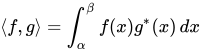
は、積分が有限値として存在するならば、内積となる。
(α, β) 上の複素値関数の列 {φn(x)} が、この内積に対し、互いに直交し、

であるとき、直交関数列であるという。
特に直交関数列のうち、ノルムが 1、すなわち
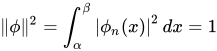
であるものものを正規直交関数列という。
また、実数値関数の列 {φn(x )} とある関数 w(x) ≥ 0 に対し、{(w(x))1/2φn(x)} が直交関数列をなし、

であるとき、この関数列を重み(荷重)w(x) の直交関数列という。
三角関数形[編集]
- 余弦関数系
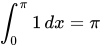
1と余弦関数による列{1, cosx, cos2x, cos3x,…}は区間 [0, π] で直交関数系を成す。


- 正弦関数系
正弦関数による列 {sinx, sin2x, sin3x,…} は区間 [0, π] で直交関数系を成す。

- 三角関数系
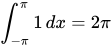
{1, cosx, sinx, cos2x, sin2x,…} は [-π, π] で直交関数系を成す。



直交多項式[編集]
エルミート多項式[編集]
関係式

で定義されるエルミート多項式は区間 (−∞, ∞) 上の重み e−x2/2 の直交関数系であり、

を満たす。
ルジャンドル多項式[編集]
関係式

で定義されるルジャンドル多項式は区間 [−1, 1] 上の直交関数系であり、

を満たす。
ラゲール多項式[編集]
関係式

で定義されるラゲール多項式は区間 [0, ∞) 上の重み e−x の直交関数系を成し、

を満たす。
チェビシェフ多項式[編集]
関係式

で定義されるチェビシェフ多項式は区間 [−1, 1] 上の重み (1 − x2)−1/2 の直交関数系を成し、

を満たす。
ゲーゲンバウアー多項式[編集]
関係式
![{\displaystyle C_{n}^{(\alpha )}(x)={\frac {(-2)^{n}}{n!}}{\frac {\Gamma (n+\alpha )\Gamma (n+2\alpha )}{\Gamma (\alpha )\Gamma (2n+2\alpha )}}(1-x^{2})^{-\alpha +1/2}{\frac {d^{n}}{dx^{n}}}\left[(1-x^{2})^{n+\alpha -1/2}\right]}](https://wikimedia.org/api/rest_v1/media/math/render/svg/443d24938c15a1014236a7b36cb424c9b01bc308)
で定義されるゲーゲンバウアー多項式は区間 [−1, 1] 上の重み (1 − x2)α − 1/2 の直交関数系を成し、
![{\displaystyle \int _{-1}^{1}(1-x^{2})^{\alpha -{\frac {1}{2}}}C_{m}^{(\alpha )}(x)C_{n}^{(\alpha )}(x)\,dx={\frac {\pi 2^{1-2\alpha }\Gamma (n+2\alpha )}{n!(n+\alpha )[\Gamma (\alpha )]^{2}}}\delta _{mn}\quad (m,n=0,1,2,\dots )}](https://wikimedia.org/api/rest_v1/media/math/render/svg/62497806953c156f1e503d72908e01cedc1673f0)
を満たす。
完備関数列[編集]
直交関数列で、

となるもののことを言う。
 (三角関数列)
関連項目[編集]