


ヒメバチ
| ヒメバチ科 | |||||||||||||||||||||
|---|---|---|---|---|---|---|---|---|---|---|---|---|---|---|---|---|---|---|---|---|---|
 キバラアメバチ亜科の1種
| |||||||||||||||||||||
| 分類 | |||||||||||||||||||||
| |||||||||||||||||||||
| 学名 | |||||||||||||||||||||
| Ichneumonidae Latreille, 1802[1] | |||||||||||||||||||||
| 和名 | |||||||||||||||||||||
| ヒメバチ科[1] | |||||||||||||||||||||
| 英名 | |||||||||||||||||||||
| Darwin wasps, Ichneumon wasps | |||||||||||||||||||||
| 亜科 | |||||||||||||||||||||
|
本文参照 |
ヒメバチは、膜翅目(ハチ目)細腰亜目(ハチ亜目)ヒメバチ科(Icheumonidae)に属する寄生蜂の総称である。ヒメバチ科は甲虫や他のハチ、チョウ、クモなどを寄主として利用する捕食寄生者であり、農地を含む陸域生態系において他の昆虫を中心とした節足動物の個体数を制御する重要な役割を担っている。
昆虫の中でも特に巨大なグループであり、世界から約25,000種が知られている。しかし、この種数は分類の遅れなどの理由で実際の多様性を反映しておらず、未記載種(新種)を含めた推定種数では60,000~100,000種に達すると考えられている。
特徴[編集]

ヒメバチの成虫は一般的に細身のハチのような体型をしているが、その体長、体色、体型などは非常に多様である[2]。ヒメバチ上科(ヒメバチ科+コマユバチ科)は、ミツバチやスズメバチなどの有剣類や他の膜翅目昆虫に比べて触角の節数が多いという特徴があり、有剣類では通常13節以下であるのに対し、ヒメバチ上科の触角はふつう16節以上ある[2][3]。
多くのヒメバチは、メスが膜翅目、甲虫目、鱗翅目、双翅目など完全変態昆虫の幼虫や蛹、クモの成体や卵嚢などに産卵し、幼虫はそれらに捕食寄生する[3]。植物組織内や繭内など何かに覆われた中にいる寄主に産卵するため、多くのヒメバチのメスは、腹端から突出した長い産卵管をもっている[2]。ほとんどの種は寄主の体内、体上や近傍に産卵するが、寄主に直接産卵せず葉上に産卵するヒメバチもいる。なおヒメバチが寄主として利用する昆虫については、Aubert (1969, 1978, 2000), Perkins (1959, 1960), Townes et al. (1965) などにまとめられている。
幼虫は細腰亜目の他の種と同様の形態を取る。幼虫が成熟すると、寄主の体内、あるいはすぐ近傍で繭を作って蛹になり、羽化して成虫となる[2]。
形態的には、ヒメバチと姉妹群を形成するコマユバチ科の種と類似するが、前翅の2m-cu横脈の有無によって区別できる(ヒメバチ科は2m-cu横脈を持ち、コマユバチ科は2m-cu横脈をもたない)[4]。
分布・生物地理[編集]
ヒメバチは全世界に分布する。従来、熱帯より温帯に種数が多いという緯度勾配があると考えられてきた。しかし、近年の熱帯地域のヒメバチ科の多様性を解明することを目的とする国際プロジェクトにより、熱帯地域においても高い多様性が存在することが示唆され始めている。
分類[編集]
ヒメバチ科には約1,600属25,000種が含まれている。2019年の研究では現生41亜科が含まれ[5]、別の研究ではコマユバチ科とされていた1亜科が本科に含まれるとされた[6]。亜科の和名については『日本産ヒメバチ目録』[7]と『日本産ヒメバチ上科(膜翅目)の属への検索表』に従った[1]。なお、アリヤドリバチ亜科Hybrizontinaeとミズバチ亜科 Agriotypinae (ミズバチ属のみ) は、独立した科として扱われたこともある[3]。
|
|
ギャラリー[編集]
-
 Ctenichneumon panzeri (ヒメバチ亜科)
 -
 Hadrodactylus villosulus (マルヒメバチ亜科)
 -
 Ophion longigena (アメバチ亜科)
 -
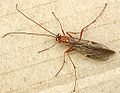 Ophion luteus オオアメバチ (アメバチ亜科)
 -
 Xanthopimpla jussilai (ヒラタヒメバチ亜科)
 -
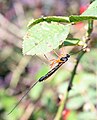 Dolichomitus imperator (ヒラタヒメバチ亜科)
 -
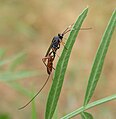 Aritranis longicauda (トガリヒメバチ亜科)
 -
 オオタバコガの蛹に産卵する Diapetimorpha introita


脚注[編集]
- ^ a b c 渡辺恭平「ヒメバチ科」、渡辺恭平・藤江隼平『日本産ヒメバチ上科(膜翅目)の属への検索表』神奈川県立生命の星・地球博物館特別出版物 第2号、神奈川県立生命の星・地球博物館、2022年、35–308頁。
- ^ a b c d Allen and Coufa (1984) p.106
- ^ a b c 平嶋・森本(2008)p.475
- ^ 平嶋・森本(2008)p.474
- ^ Andrew M.R. Bennett, Sophie Cardinal, Ian D. Gauld & David B. Wahl, “Phylogeny of the subfamilies of Ichneumonidae (Hymenoptera),” Journal of Hymenoptera Research Volume 71, International Society of Hymenopterists, 2019, Page 1-156.
- ^ a b Donald L. J. Quicke, Andrew D. Austin, Erinn P. Fagan-Jeffries, Paul D. N. Hebert & Buntika A. Butcher, “[ Molecular phylogeny places the enigmatic subfamily Masoninae within the Ichneumonidae, not the Braconidae],” Zoologica Scripta, Volume 49, Issue 1, Royal Swedish Academy of Sciences, 2019, Pages 64-71.
- ^ 小西和彦「日本産ヒメバチ目録」2021年6月2日(2014年10月15日閲覧)
参考文献[編集]


- Allen, Douglas C., and James E. Coufa (1984) Introduction to Forest Entomology: A Training Manual for Forest Technicians. Syracuse University Press; 1st edition ISBN 978-0815623199
- Aubert, J. F. (1969): Les Ichneumonides ouest-palearctiques et leurs hotes 1. Pimplinae, Xoridinae, Acaenitinae ["The Western Palearctic ichneumon wasps and their hosts. 1. Pimplinae, Xoridinae, Acaenitinae"]. Laboratoire d'Evolution des Etres Organises, Paris. [in French]
- Aubert, J. F. (1978): Les Ichneumonides ouest-palearctiques et leurs hotes 2. Banchinae et Suppl. aux Pimplinae ["The Western Palearctic ichneumon wasps and their hosts. 2. Banchinae and supplement to the Pimplinae"]. Laboratoire d'Evolution des Etres Organises, Paris & EDIFAT-OPIDA, Echauffour. [in French]
- Aubert, J. F. (2000): Les ichneumonides oeust-palearctiques et leurs hotes. 3. Scolobatinae (=Ctenopelmatinae) et suppl. aux volumes precedents [The West Palaearctic ichneumonids and their hosts. 3. Scolobatinae (= Ctenopelmatinae) and supplements to preceding volumes]. Litterae Zoologicae 5: 1-310. [French with English abstract]
- Bennett AMR, Cardinal S, Gauld ID, Wahl DB (2019) Phylogeny of the subfamilies of Ichneumonidae (Hymenoptera). Journal of Hymenoptera Research 71: 1–156. https://doi.org/10.3897/jhr.71.32375
- Broad GR, Shaw MR, Fitton MG. (2018) Ichneumonid wasps (Hymenoptera: Ichneumonidae): their classification and biology. Handbooks for the Identification of British Insects 7 (12): 1–418.
- Klopfstein S, Langille B, Spasojevic T, Broad GR, Cooper SJB, Austin AD, Niehuis O. 2019. Hybrid capture data unravel a rapid radiation of pimpliform parasitoid wasps (Hymenoptera: Ichneumonidae: Pimpliformes). Systematic Entomology 44: 361–383.
- Klopfstein S, Santos BF, Shaw MR, Alvarado M, Bennett AMR, Dal Pos D, Giannotta M, Herrera Florez AF, Karlsson D, Khalaim AI, Lima AR, Mikó I, Sääksjärvi IE, Shimizu S, Spasojevic T, van Noort S, Vilhelmsen L, Broad GR (2019) Darwin wasps: new name heralds renewed efforts to unravel evolutionary history of Ichneumonidae. Entomological Communications 1: ec01006.
- 小西和彦 (2019) 日本産ヒメバチ目録 Check list of Japanese Ichneumonidae (https://sites.google.com/site/ichneumonidjp/)
- Perkins, J. F. (1959): Ichneumonidae, key to subfamilies and Ichneumoninae – 1. Handbook for the Identification of British Insects 7(part 2ai): 1–116.
- Perkins, J. F. (1960): Hymenoptera: Ichneumonoidea: Ichneumonidae, subfamilies Ichneumoninae 2, Alomyinae, Agriotypinae and Lycorininae. Handbook for the Identification of British Insects 7(part 2aii): 1–96.
- Quicke DLJ (2015) The Braconid and Ichneumonid Parasitoid Wasps. Biology, systematics, evolution and ecology. John Wiley & Sons, Ltd. 681 pp.
- Quicke DLJ, Austin AD, Fagan‐Jeffries EP, Hebert PDN, Butcher BA (2019) Molecular phylogeny places the enigmatic subfamily Masoninae within the Ichneumonidae, not the Braconidae. Zoologica Scripta online first. https://doi.org/10.1111/zsc.12390
- Quicke DLJ, Fitton MG, Broad GR, Crocker B, Laurenne NM, Miah MI (2005) The parasitic wasp genera Skiapus, Hellwigia, Nonnus, Chriodes, and Klutiana (Hymenoptera, Ichneumonidae): recognition of the Nesomesochorinae stat. rev. and Nonninae stat. nov. and transfer of Skiapus and Hellwigia to the Ophioninae. Journal of Natural History 39: 2559–2578.
- Quicke DLJ, Laurenne NM, Fitton MG, Broad GR (2009) A thousand and one wasps: a 28S and morphological phylogeny of the Ichneumonidae (Insecta: Hymenoptera) with an investigation into alignment parameter space and elision. Journal of Natural History 43: 1305–1421.
- Robert G. Foottit and Peter Holdridge Adley (2009) Insect Biodiversity: Science and Society. Wiley-Blackwell ISBN 978-1405151429
- Townes, H. T. ; Momoi, S. A. & Townes, M. (1965): Catalogue and Reclassification of Eastern Palearctic Ichneumonidae Memoirs of the American Entomological Institute 5: 1-661 pages.
- Wahl DB (1993) Key to subfamilies of Holarctic and Neotropical Ichneumonidae. In: Goulet H, Huber JT, eds. Hymenoptera of the world: An identification guide to families. Ottawa: Agriculture Canada, 396–509. [Free Access]
- 渡辺恭平, 伊藤誠人, 藤江隼平, 清水壮 (2019) Information station of Parasitoid wasps (https://himebati.jimdofree.com/) (2019年12月14日閲覧)
| 典拠管理データベース: 国立図書館 |
|---|
